
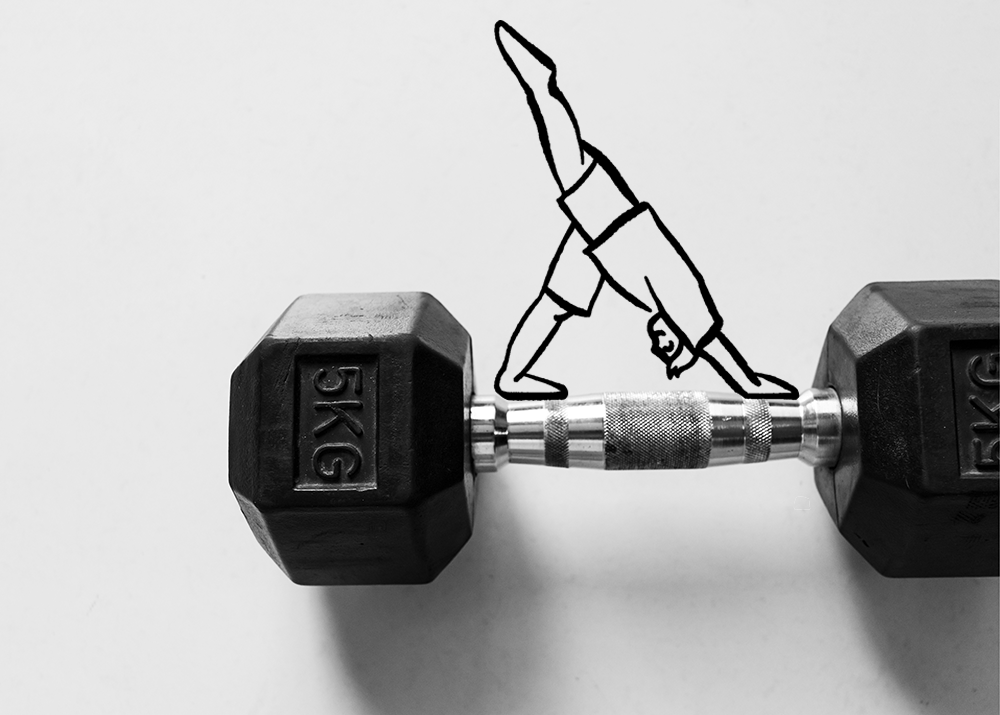
Is the point of yoga to exercise?

I just got an email promoting a webinar: Strength Training After 50: Is Your Yoga Practice Missing This Crucial Element? It argues that most yoga classes fall short when it comes to building muscle and bone density.

As someone over 50, my response is: No kidding?! If you want to build muscle and bone density at any age, lift weights.

Can yoga be physically challenging? Absolutely. But is “exercise” the point of yoga? That depends on who you ask and which era of yoga history you’re looking at. (Asana has, at times, been used to train warriors.) What I can tell you is that every expert yoga teacher trainer I know also recommends strength training, because certain movements essential to physical strength, (especially in aging bodies) like push-pull patterns in the shoulder, simply aren’t addressed adequately by yoga poses.

My yoga LLC is named “Outside-In” because of the way the koshas are described: as layers of the self moving from the outermost (anamaya kosha, the physical body) to the innermost (anandamaya kosha, the layer of the soul). Viewing yoga purely as exercise leaves out this beautiful concept and the potential a practice has to help you move through those layers, to connect with yourself.

Yoga has tremendous benefits for healthy aging. So does lifting weights. The two are a terrific combination. One of my favorite teacher training assignments is a sequence I designed called “After Leg Day,” built to help legs, hips, and glutes recover. And as my trainer likes to say, “lifting pretty” (meaning weight that isn’t truly challenging your body) isn’t going to build much strength.

It’s all about your goals. For your whole self, and all its layers.

(Photo collage by Joy Panos Stauber using images by Amanda Regh and Get Illustrations from Unsplash)
Yoga and Ch-ch-ch-changes

Our bodies change and evolve. Consider how yoga can support the body you are inhabiting today. Learning to listen to your body can help you give it the support it needs (the support YOU need) through many phases of life.

People say that our bodies are metaphors. And that our bodies help us process emotions. The older I get, the more true this seems. Tuning into my body is tuning in to my self. In yoga philosophy, the physical practice of yoga is a way to access deeper layers of your self. (For more on that, look up The 5 Koshas, or read the amazing Light on Life by B.K.S. Iyengar.)

You do not need to seek freedom in a different land, for it exists with your own body, heart, mind, and soul.
― B.K.S. Iyengar, Light on Life

I’m sure I’m not the only one who feels like I’ve lived in many versions of my body. A self-conscious teenage body. An adult body that’s known many sizes and weights. A pregnant body with a ravenous baby in the belly. A postpartum, relaxin-filled, breastfeeding body. A perimenopausal body with musculoskeletal glitches. And now, a menopausal body that feels more strong and balanced than ever—thanks to a year of weight training alongside consistent yoga.

My yoga practice has evolved as much as my body has. In my 30s, I was ambitious—both in my career and in achieving more challenging poses. During pregnancy and childbirth, the meditative aspects and breathwork were invaluable. As a busy mom, I craved Gentle Yoga to create space and grounding. In high-stress “sandwich generation” times, Restorative Yoga helped soothe my nervous system, so I could stay present and support others.

One of my teachers, now in her 80s, often reminds us to thank our bodies—to notice how lucky we are to simply be able to show up and move in whatever way works today.

Our bodies change every day, sometimes moment to moment. As a teacher, I want to help you drop into your body. To notice, appreciate, and care for—maybe even love—the body you’re in right now.

”You don’t need to earn rest.”

You don’t need to earn rest.” is my favorite quote — and concept — from Gentle and Restorative yoga teacher training with Kerry Maiorca. In our always-connected, overly-busy world, it’s important that we give ourselves permission to rest.

Our value as humans is not in our productivity. Allowing ourselves (our bodies and our minds) to rest is about showing ourselves compassion. Quality rest helps us feel good, be more creative, and function better in all aspects of life. It’s true that you can’t pour from an empty cup, or as some say in the business world, sometimes you have to “slow down to go fast.”

You can’t make yourself be compassionate. You can only keep stepping back and becoming a larger container in which compassion wants to live. The practice should open us up, and crack open our hearts again and again.
–Judith Hanson Lasater

(Photo adapted from Wouter De Praetere on Unsplash. Thank you!)

What if you made a Restorative Resolution?

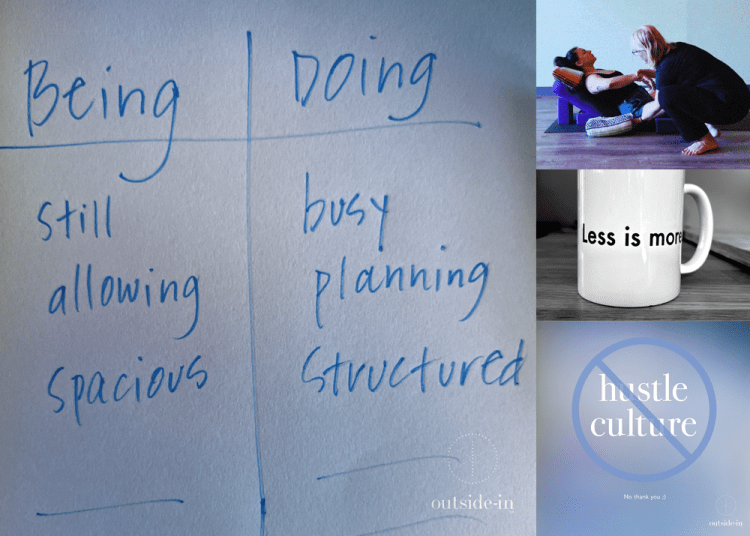
Collage with nnotes about Being vs. Doing, Joy setting up a student in a restorative pose, a coffee mug that says "Less is More", and a "no hustle culture" instagram image — all ©Outside-In Studio LLC

This time of year, we’re flooded with messages about doing more — work out more, eat better, be more productive. Resolutions tend to be about improving yourself through action.

In my classes this month, I’m inviting people to think about it differently.

Instead of a resolution about DOing, what if you made one about BEing?

We live in a culture where it’s easy to feel like we should always be doing more. But we can choose to counter that. To stop “shoulding” on ourselves.

Consider what animals do in winter: they hibernate. Nature slows down, and we are part of nature. This is a season of rest and reflection; an invitation to notice that natural rhythm and actually participate in it.

So as the busy-ness of the holidays fades and a new year opens up, I invite you to make a different kind of resolution. One rooted in being rather than doing.

Maybe you want to BE more present — for yourself, your colleagues, your loved ones. Maybe you want to feel centered and grounded, even when your kid is having a meltdown or work is overwhelming. Maybe you want to release patterns or beliefs that no longer serve you. Or maybe you want to create small pockets of stillness where you can hear your own intuition instead of talking yourself out of it.

Things don’t change overnight. But incremental progress is still progress.

Let these ideas percolate. Give your body and mind time to process. Over the coming days or weeks, create some quiet space to listen inward, and you’ll know what your restorative resolution is.